Back to Ed's Home Page

Flies like a baby 182 but with lighter controls and less fuel burn
This beautiful straight-tail Cessna has everything you'd want:
Stunning 1959 Cessna -- 2002 Oshkosh award winner.
Economical 180 HP Lycoming (replaces the original geared engine), less than 800 since new! But the engine recently developed
high oil pressure that could not be diagnosed, so the engine was majored. Nothing was found to cause the high oil pressure, but
some corrosion was found and fixed. The bearings and valves were replaced, so this is effectively a brand new engine! The
constant speed prop requires the 100 hour eddy current inspection, but I do have available a new prop (not included) with
70 hours. This gorgeous Cessna also has an STOL kit, gap seals,
52 gallon fuel tanks,
new paint and glass, clean mostly original
interior, modern gyros, Cleveland wheels and brakes, amazing avionics
including an IFR GPS/comm legal for approaches and
an SL-30 for ILS approaches.
It's stable,
very easy to fly on instruments,
even in turbulence, and the avionics
do everything you
want!
Now based at Cedar Rapids, IA, which has airline service so it will be easy to come check it out. Before the major overhaul,
the asking price was $59,000.
Ed Wischmeyer, 319 491-6904 aircraft@mchsi.com
Back to Ed's Home Page
Flies like a baby 182 but with lighter controls and less fuel burn
This beautiful straight-tail Cessna has everything you'd want:
Engine and Airframe |
Avionics & Cabin | Trips Made |
|---|---|---|
| Lyc O360-A1A , <800 hrs since new, 0 SMOH | IFR GPS with moving map | Seattle - Oshkosh, 3 x |
| Constant speed prop | UPSAT (nee Garmin) avionics | Arizona to Michigan, 3 x |
| Horton STOL kit | Comm tuning from GPS database | Arizona to Houston, 2x |
| Gap seals | Automatic Morse ID on VOR/ILS | Iowa to Arizona |
| Cleveland wheels and brakes | Four place autosquelch intercomm | Arizona to Iowa (one way) |
| 52 gallon fuel tanks, 10 more than a 172's | Modern gyros, custom panel | And lots of short, fun hops! |
| New paint, and it looks that good in the flesh! | Heated pitot tube | |
| New glass, including one piece windshield | Shoulder harnesses | |
| Opening windows on both sides | ||
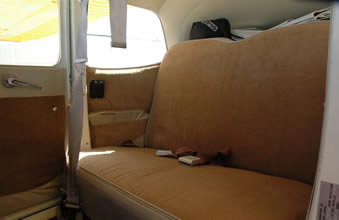
| Very clean, mostly original interior |
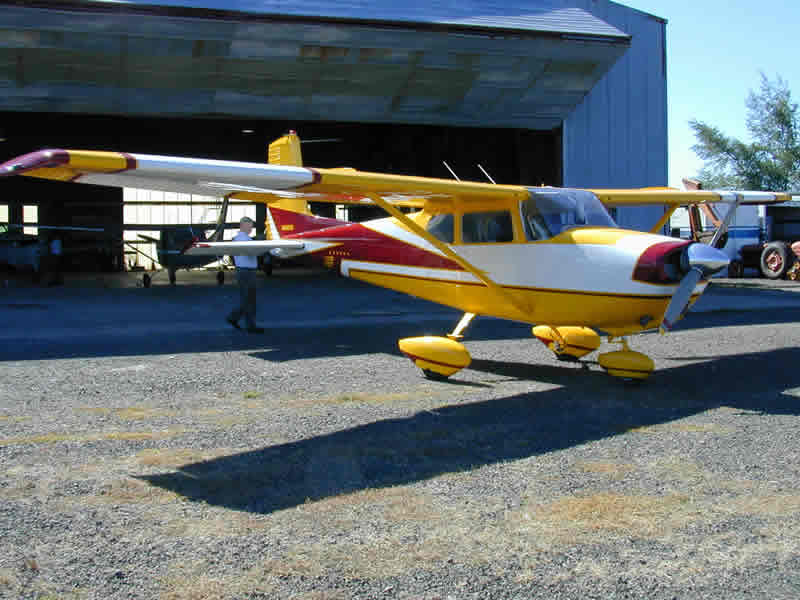
The "Bumblebee" in its new paint, the day we picked it up from the paint shop. This is much the same as the original factory paint scheme if you take the yellow to bare metal. Bob Fitts of Independence, Oregon, did the paint for us. Thanks, Bob! This won us an Oshkosh award in the Contemporary class, "Outstanding Cessna 170/172/175," in 2002. |
 |
|---|
Note the STOL kit fences on top of the wing. Not visible are the gap seals for the flaps and ailerons. At 6,500', about 22" x 2400 RPM, we've recorded a two way average of 117 kt. With the STOL kit, a comfortable takeoff is 20 degrees of flaps, a sea level ground roll of about 600 feet, liftoff and climb at 65 MPH. Density altitude is much less noticeable because of the extra takeoff thrust generated by the constant speed prop. Stalls are benign. Fuel tanks are 52 gallons (48 usable), ten gallons more than a C172, and this imakes a big difference with a 180HP engine. And density altitude is not much of a factor for this powerful plane. |
|---|
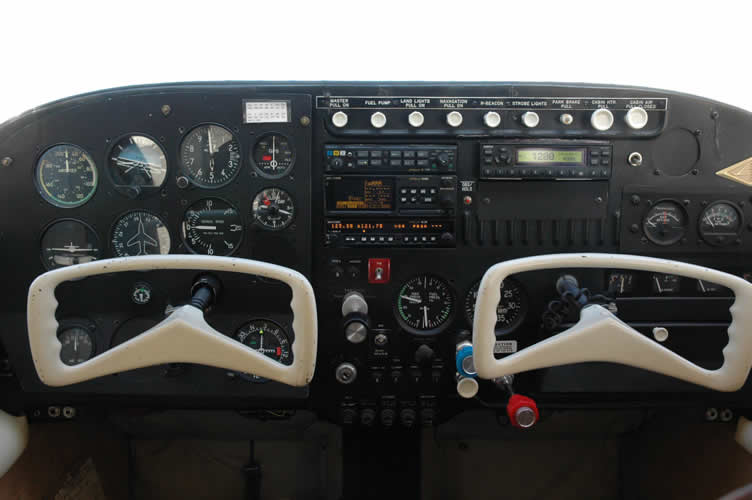 |
Here's the panel, with the left side custom made to make the instruments more readable, especially at night. The UPSAT radios include an IFR GPS/COMM and a NAV/COMM. The GPS includes a moving map, handy for avoiding airspaces. Once you access an airport on the GPS, you can get all its frequencies on the comms. Each comm can have an active frequency plus a frequency that's monitored when there is no action on the active frequency. Also, the VOR/ILS can be tuned to one frequency while getting cross bearings from another VOR simultaneously. And, it will check the Morse ID and display it. The transponder has pushbutton setting of the code, much easier and faster than knobs, plus it has timers for flight time, and counting up and down. And, the audio panel has fully automatic squelch on the 4 place intercomm. |
|---|
 |
 |
 |
|---|
And what would it cost to duplicate what you'll get? These numbers are probably way conservative:
$25,000 for a worn out Cessna 175 airframe
$5,000 First annual to fix things (we spent half again this much, even though the plane had a fresh annual when we bought it).
$30,000+ 180 HP Lycoming, constant speed prop, prop governor, motor mount, STC
$5,000+ STOL kit, gap seals, and installation
$10,000 Paint
$30,000 Avionics, gyros, and new panel
and...
one piece windshield, new glass all around, Cleveland wheels and brakes, shoulder harness, heated pitot tube
$100,000+ total cost to duplicate
We've got over $75,000 in ours -- at prices ten years ago, plus maybe $12,000 for the major. You'll enjoy this plane, just as we have!
Ed Wischmeyer, 319 491-6904 aircraft@mchsi.com